
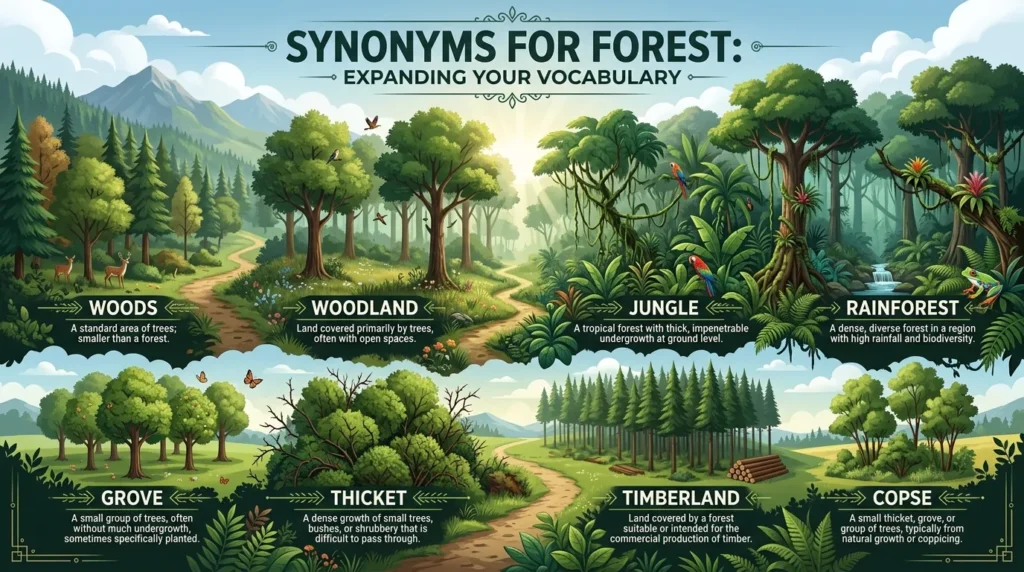
Have you ever stepped into a dense woodland where the sunlight filters through towering trees, birds sing from hidden branches, and every path feels like the beginning of an adventure? Forests have long inspired stories, poetry, and a deep connection with nature. Yet when writing, speaking, or creating content, using the same word repeatedly can make your language feel repetitive. That’s where synonyms for forest become incredibly useful.
Imagine reading a travel blog about a beautiful green place. If the writer uses the word “forest” in every sentence, the article may feel boring. But when the writer uses words like woods, jungle, grove, or woodland, the writing becomes more colorful and enjoyable.
For example, a student writing an essay about nature may use woodland instead of forest. A blogger describing a hiking trip may choose woods. These small changes improve writing quality and vocabulary.
The meaning of forest is simple: a large area covered with many trees.
Learning forest-related words is useful for:
- Students writing essays and school projects
- Bloggers creating engaging content
- Content writers improving readability
- Daily English users expanding vocabulary
The more nature words you know, the easier it becomes to express your ideas clearly and creatively. In this guide, we’ll explore the most useful synonyms for forest, their meanings, and examples of how to use them effectively. By the end, you’ll have a richer vocabulary and a better appreciation for the diverse ways nature can be described.
“A rich vocabulary helps simple ideas sound vivid and memorable.”
Comparison Table of Forest Synonyms
| Keyword | Meaning | Usage Type | Context |
| Woods | Small forest area | Casual | Daily use |
| Woodland | Land covered with trees | Neutral | Nature writing |
| Jungle | Dense tropical forest | Casual | Travel, wildlife |
| Grove | Small group of trees | Neutral | Nature descriptions |
| Thicket | Dense shrubs and trees | Descriptive | Outdoor writing |
| Rainforest | Forest with heavy rainfall | Educational | Geography |
| Copse | Small wooded area | Formal | Literature |
| Timberland | Land with trees for wood | Professional | Forestry |
| Wildwood | Untamed forest | Emotional | Creative writing |
| Bushland | Land with bushes and trees | Regional | Environmental topics |
Synonyms for forest are words that have a similar meaning to the word forest. A forest is a large area filled with trees, plants, animals, and natural life. Learning synonyms for forest helps you describe nature in different ways and makes your writing more interesting. Many writers, students, and English learners use synonyms for forest to avoid repeating the same word again and again.
1. Woods
Meaning: A smaller area of trees than a forest.
Examples:
- We walked through the woods after lunch.
- The woods looked beautiful in autumn.
2. Woodland
Meaning: Land covered with many trees.
Examples:
- Deer lived in the woodland nearby.
- The woodland was quiet and peaceful.
3. Jungle
Meaning: A thick tropical forest with many plants.
Examples:
- Monkeys jumped through the jungle.
- The jungle was full of wildlife.
4. Grove
Meaning: A small group of trees.
Examples:
- We rested in a grove of oak trees.
- The grove provided cool shade.
5. Thicket
Meaning: A dense area of bushes and small trees.
Examples:
- A rabbit hid in the thicket.
- The thicket was hard to cross.
6. Rainforest
Meaning: A forest that gets a lot of rain.
Examples:
- The rainforest is home to many animals.
- Scientists study plants in the rainforest.
7. Copse
Meaning: A small patch of trees.
Examples:
- Birds nested in the copse.
- The copse stood beside the field.
8. Timberland
Meaning: Forest land used for wood production.
Examples:
- Workers managed the timberland carefully.
- The timberland stretched for miles.
9. Wildwood
Meaning: A natural and untamed forest.
Examples:
- The wildwood felt mysterious.
- We explored the wildwood trail.
10. Bushland
Meaning: Land covered with shrubs and trees.
Examples:
- Kangaroos crossed the bushland.
- The bushland was very dry.
11. Arboretum
Meaning: A place where many trees are grown.
Examples:
- We visited the arboretum on Sunday.
- The arboretum displayed rare trees.
12. Greenbelt
Meaning: Natural land protected from development.
Examples:
- The city preserved the greenbelt.
- Families enjoyed walks in the greenbelt.
13. Tree Farm
Meaning: Land where trees are grown for use.
Examples:
- The tree farm supplied local wood.
- Workers planted new trees each year.
14. Woodland Area
Meaning: A region covered with trees.
Examples:
- The woodland area attracted hikers.
- Birds filled the woodland area with songs.
15. Forestland
Meaning: Land occupied by forests.
Examples:
- The forestland supports wildlife.
- Fires damaged some forestland.
16. Pinewood
Meaning: A forest mainly made of pine trees.
Examples:
- The pinewood smelled fresh.
- We camped near the pinewood.
17. Oakwood
Meaning: An area filled with oak trees.
Examples:
- The oakwood looked beautiful.
- Squirrels lived in the oakwood.
18. Birchwood
Meaning: A woodland of birch trees.
Examples:
- The birchwood shined in sunlight.
- We walked through the birchwood.
19. Cedar Forest
Meaning: A forest of cedar trees.
Examples:
- The cedar forest smelled wonderful.
- Birds nested in the cedar forest.
20. Evergreen Forest
Meaning: A forest with trees that stay green all year.
Examples:
- The evergreen forest remained green in winter.
- We hiked through the evergreen forest.
21. Dense Woodland
Meaning: A thick area of trees.
Examples:
- The dense woodland blocked sunlight.
- Animals hid in the dense woodland.
22. Natural Reserve
Meaning: Protected land with natural habitats.
Examples:
- The natural reserve protects wildlife.
- Tourists visited the natural reserve.
23. Wilderness
Meaning: A wild natural area.
Examples:
- The wilderness was untouched.
- They camped in the wilderness.
24. Backwoods
Meaning: A remote wooded area.
Examples:
- The cabin stood in the backwoods.
- Few people visited the backwoods.
25. Woodlot
Meaning: A small area of woodland.
Examples:
- The farmer owned a woodlot.
- Birds gathered in the woodlot.
“Nature speaks through every tree, leaf, and forest path.”
26. Forest Preserve
Meaning: A protected forest area.
Examples:
- Families visited the forest preserve.
- The forest preserve protects wildlife.
27. Woodland Preserve
Meaning: Protected land covered with trees.
Examples:
- The woodland preserve remained peaceful.
- Visitors followed marked trails there.
28. Primeval Forest
Meaning: A very old natural forest.
Examples:
- The primeval forest contained ancient trees.
- Scientists studied the primeval forest.
29. Virgin Forest
Meaning: A forest that has never been cut down.
Examples:
- Rare plants grew in the virgin forest.
- The virgin forest stayed untouched.
30. Old-Growth Forest
Meaning: A forest with very old trees.
Examples:
- The old-growth forest attracted researchers.
- Tall trees filled the old-growth forest.
31. Tropical Forest
Meaning: A warm forest found near the equator.
Examples:
- Colorful birds lived in the tropical forest.
- Heavy rain fed the tropical forest.
32. Temperate Forest
Meaning: A forest in a mild climate.
Examples:
- Many animals lived in the temperate forest.
- The temperate forest changed with the seasons.
33. Boreal Forest
Meaning: A cold northern forest.
Examples:
- The boreal forest covered large areas.
- Moose wandered through the boreal forest.
34. Mangrove Forest
Meaning: A forest growing near salty water.
Examples:
- Fish sheltered in the mangrove forest.
- The mangrove forest protected the shoreline.
35. Cloud Forest
Meaning: A forest often covered in clouds.
Examples:
- The cloud forest felt cool and damp.
- Many unique plants grew there.
36. Canopy Forest
Meaning: A forest with a thick tree cover above.
Examples:
- Sunlight barely entered the canopy forest.
- Birds flew above the canopy forest.
37. Brushwood
Meaning: Land covered with small trees and bushes.
Examples:
- The brushwood spread across the hill.
- Small animals hid in the brushwood.
38. Underwood
Meaning: Small trees and plants beneath larger trees.
Examples:
- The underwood was thick and green.
- We carefully walked through the underwood.
39. Timber Forest
Meaning: A forest used for producing wood.
Examples:
- Workers managed the timber forest responsibly.
- The timber forest supported local jobs.
40. Greenwood
Meaning: A lush and green forest.
Examples:
- The greenwood looked beautiful in spring.
- We enjoyed a picnic in the greenwood.
41. Sylva
Meaning: A literary word for a forest.
Examples:
- The poem described a peaceful sylva.
- Artists often painted scenes of sylva.
42. Wooded Area
Meaning: An area filled with trees.
Examples:
- The wooded area provided shade.
- Children explored the wooded area.
43. Forest Region
Meaning: A large area known for forests.
Examples:
- The forest region attracted tourists.
- Many animals lived in the forest region.
44. Tree-Covered Land
Meaning: Land covered by many trees.
Examples:
- The tree-covered land looked beautiful from above.
- Farmers protected nearby tree-covered land.
45. Nature Reserve
Meaning: Protected land for plants and animals.
Examples:
- The nature reserve welcomed visitors.
- Rangers cared for the nature reserve.
46. Conservation Forest
Meaning: A forest protected for nature.
Examples:
- The conservation forest supported biodiversity.
- Volunteers worked in the conservation forest.
47. National Forest
Meaning: A forest managed by a government.
Examples:
- We camped in the national forest.
- The national forest covered thousands of acres.
48. Woodland Tract
Meaning: A specific area of woodland.
Examples:
- The woodland tract bordered the river.
- Hikers crossed the woodland tract.
49. Forested Land
Meaning: Land covered with forests.
Examples:
- The forested land stretched far away.
- Wildlife thrived on the forested land.
50. Tree Wilderness
Meaning: A wild area full of trees.
Examples:
- The tree wilderness felt untouched.
- Adventurers explored the tree wilderness.
5 Most Common Antonyms for Forest
A forest is a large area covered with trees, plants, and wildlife. When looking for antonyms of forest, we consider words that describe places with little or no tree cover. Here are five common antonyms and their meanings.
1. Desert
Meaning: A dry, barren region with very little rainfall and vegetation.
Explanation: Unlike a forest filled with trees and greenery, a desert is mostly covered with sand, rocks, and sparse plant life.
2. Plain
Meaning: A large, flat area of land with few or no trees.
Explanation: Plains are open landscapes that contrast with the dense tree coverage found in forests.
3. Grassland
Meaning: A region dominated by grasses rather than trees.
Explanation: Grasslands have wide-open spaces and minimal tree growth, making them the opposite of forests in terms of vegetation.
4. Tundra
Meaning: A cold, treeless biome found in Arctic and high-mountain regions.
Explanation: Unlike forests, tundras lack significant tree growth because of extremely low temperatures and frozen soil.
5. Wasteland
Meaning: An uncultivated or barren area with little plant life.
Explanation: A wasteland contrasts sharply with the rich biodiversity and dense vegetation typical of a forest.
Final Note
While exact antonyms can vary depending on context, desert, plain, grassland, tundra, and wasteland are among the most commonly used opposites of forest because they represent landscapes with few or no trees.
Conclusion
Learning synonyms for forest is a simple way to improve your English vocabulary and make your writing more engaging. When you know different words for the same idea, you can express yourself more clearly and avoid repeating the same word too often. Whether you choose woods, grove, woodland, jungle, or another alternative, each word adds a slightly different image and feeling to your writing.
For students, synonyms for forest can improve essays, assignments, and school projects and for bloggers, they help create more interesting articles that keep readers engaged. For content writers, a varied vocabulary improves readability and strengthens SEO content and for daily English users, learning new words builds confidence in conversations and communication.
Try using these synonyms in your emails, essays, social media posts, journal entries, and daily conversations. Start with a few words, practice them regularly, and soon they will become a natural part of your vocabulary.
Understanding these synonyms for forest also helps improve reading comprehension and strengthens overall language skills. Whether you are writing a story, preparing educational content, or simply expanding your vocabulary, using varied terms for forested landscapes can make your writing more engaging and impactful.
“Every new word you learn gives your thoughts a stronger voice.”
“Good writing begins with good word choices.”
“A growing vocabulary opens doors to better communication and creativity.”

I am the founder of SynonymOver.com, a platform dedicated to providing accurate, easy-to-understand synonyms that help readers choose the right words with confidence. I create clear, SEO-driven content focused specifically on synonyms, word meanings, and precise language use.
My work is built on simplicity, accuracy, and practical usage—ensuring that every synonym is not just listed, but explained in a way that makes it easy to apply in real writing. I focus on delivering user-friendly content for students, writers, and professionals looking to improve their vocabulary.
What sets my work apart is a strong focus on clarity and relevance, offering meaningful alternatives rather than generic word lists. I continuously apply modern SEO strategies to ensure my content reaches and benefits a wider audience.