Ever found yourself repeating the word “with” again and again while writing, and wishing your sentences sounded more polished and varied? You’re not alone. Expanding your vocabulary with the right synonyms for with can instantly elevate your writing, making it more engaging, precise, and professional. That’s where synonyms for with can help you sound fresh and natural.
Imagine you’re writing a message: “I went to the market with my friend.” Now try: “I went to the market along with my friend.” It feels better, right? The word synonyms for with means words you can use instead of “with.” “With” is a simple word. It shows connection, togetherness, or use.
Students use it in essays. Bloggers use it to avoid repetition. Content writers need variety, and daily English users sound more fluent. For example, instead of saying “tea with sugar,” you can say “tea including sugar.” These small changes make your English stronger.
Learning synonyms for with helps you write clearly. It also helps you speak in a more natural way. So, let’s explore simple and useful options you can start using today.
✨ Top 5 synonyms for with list ✨
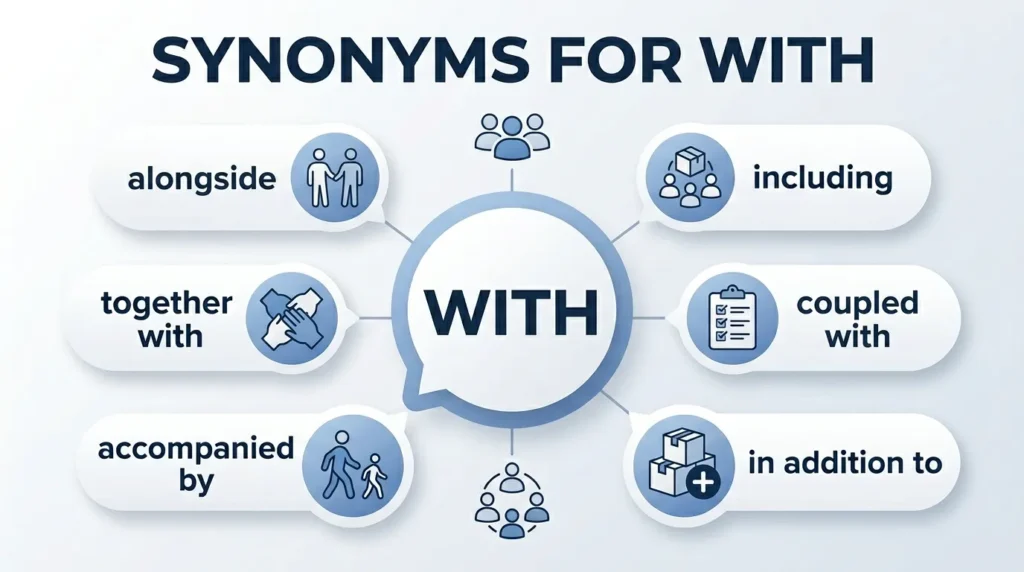
- along with • together with • alongside • plus • including
✨ Next Top 5 synonyms for with list ✨
- accompanied by • in company with • in association with • coupled with • as well as
Pronunciation of “with”
- Phonetic: with
- IPA: /wɪð/ or /wɪθ/
- Simple: sounds like “with”
Syllables of “with”
- with (1 syllable)
- Very short and easy word
List of 50 synonyms for with
Along with
Meaning
It means together with someone or something.
Examples
- I went along with my brother.
- She brought snacks along with drinks.
Together with
Meaning
It means in the company of someone.
Examples
- He came together with his friend.
- She works together with her team.
Alongside
Meaning
It means next to or together.
Examples
- He sat alongside me.
- She worked alongside her teacher.
Plus
Meaning
It means adding something more.
Examples
- I bought rice plus beans.
- He wants tea plus sugar.
Including
Meaning
It means having something as part.
Examples
- I like fruits including apples.
- The box has toys including cars.
Accompanied by
Meaning
It means going with someone.
Examples
- She came accompanied by her mom.
- He traveled accompanied by friends.
In company with
Meaning
It means being with someone.
Examples
- I walked in company with him.
- She stayed in company with family.
In association with
Meaning
It means connected with something.
Examples
- He worked in association with a group.
- The event is in association with a school.
Coupled with
Meaning
It means joined with something.
Examples
- Hard work coupled with effort wins.
- Talent coupled with practice helps.
As well as
Meaning
It means also or in addition.
Examples
- I like tea as well as coffee.
- She sings as well as dances.
In addition to
Meaning
It means adding more things.
Examples
- I study in addition to work.
- He plays in addition to studies.
Amid
Meaning
It means surrounded by.
Examples
- He stood amid the crowd.
- She smiled amid noise.
Among
Meaning
It means in the middle of many.
Examples
- He sat among friends.
- She stood among children.
Amidst
Meaning
It means in the middle of something.
Examples
- He walked amidst trees.
- She laughed amidst chaos.
Featuring
Meaning
It means showing something.
Examples
- The show is featuring songs.
- The menu is featuring sweets.
Containing
Meaning
It means having inside.
Examples
- The box is containing books.
- The bottle is containing water.
Holding
Meaning
It means having something.
Examples
- She is holding flowers.
- He came holding a bag.
Bearing
Meaning
It means carrying something.
Examples
- He came bearing gifts.
- She walked bearing books.
Sporting
Meaning
It means wearing something.
Examples
- He came sporting a hat.
- She is sporting new shoes.
Using
Meaning
It means with the help of.
Examples
- I cut it using a knife.
- She wrote using a pen.
Via
Meaning
It means through something.
Examples
- He sent it via email.
- She came via bus.
By means of
Meaning
It means using something.
Examples
- He solved it by means of math.
- She paid by means of card.
Through
Meaning
It means by using something.
Examples
- He learned through practice.
- She won through effort.
Under
Meaning
It means below or with control.
Examples
- He works under a boss.
- She studies under guidance.
Within
Meaning
It means inside something.
Examples
- He stayed within limits.
- She worked within rules.
Beside
Meaning
It means next to.
Examples
- He sat beside me.
- She stood beside her friend.
Besides
Meaning
It means in addition.
Examples
- I like tea besides coffee.
- He plays besides studies.
Next to
Meaning
It means close to something.
Examples
- Sit next to me.
- He stood next to her.
Close to
Meaning
It means near something.
Examples
- Stay close to me.
- He lives close to school.
Near
Meaning
It means not far.
Examples
- Sit near me.
- The shop is near home.
By
Meaning
It means beside or using.
Examples
- Sit by me.
- He traveled by car.
In
Meaning
It means inside or with.
Examples
- He came in a group.
- She walked in silence.
On
Meaning
It means touching or using.
Examples
- He spoke on phone.
- She worked on laptop.
Attached to
Meaning
It means joined to something.
Examples
- The key is attached to ring.
- The file is attached to email.
Connected with
Meaning
It means linked to something.
Examples
- He is connected with team.
- She is connected with school.
Linked with
Meaning
It means joined together.
Examples
- His name is linked with success.
- She is linked with the group.
Related to
Meaning
It means having a connection.
Examples
- This topic is related to science.
- That idea is related to life.
Associated with
Meaning
It means connected to something.
Examples
- He is associated with club.
- She is associated with charity.
Paired with
Meaning
It means matched together.
Examples
- Shoes paired with jeans look nice.
- Rice paired with curry tastes good.
Matched with
Meaning
It means fitting together.
Examples
- The shirt is matched with pants.
- Colors matched with style.
Combined with
Meaning
It means mixed together.
Examples
- Effort combined with skill wins.
- Tea combined with milk tastes good.
Blended with
Meaning
It means mixed smoothly.
Examples
- Colors blended with each other.
- Flavors blended with spices.
Joined with
Meaning
It means put together.
Examples
- Hands joined with friends.
- Ideas joined with plans.
United with
Meaning
It means brought together.
Examples
- People united with hope.
- Teams united with goal.
Partnered with
Meaning
It means worked together.
Examples
- He partnered with a company.
- She partnered with a friend.
Collaborating with
Meaning
It means working together.
Examples
- He is collaborating with team.
- She is collaborating with artists.
Dealing with
Meaning
It means handling something.
Examples
- He is dealing with problems.
- She is dealing with work.
Engaging with
Meaning
It means interacting.
Examples
- He is engaging with people.
- She is engaging with audience.
Interacting with
Meaning
It means talking or working together.
Examples
- He is interacting with friends.
- She is interacting with kids.
Conclusion
In everyday communication, choosing the right words can subtly shape how your message is received. Exploring synonyms for “with” allows you to add clarity, variety, and precision to your writing. Whether you’re aiming for a formal tone, creative expression, or simple readability, alternatives like alongside, together with, accompanied by, or in association with can make your content more engaging and contextually accurate.
Learning synonyms for with is a smart step toward better English. It helps you avoid repeating the same word again and again. When you use different words, your writing becomes fresh and clear. Your blog posts sound more professional. Your speaking becomes more natural and confident.
Students can improve essays. Bloggers can improve SEO. Writers can add variety, and daily users can communicate better. Start small. Try one or two new words each day. Use them in emails, school work, and daily talks. The more you practice, the easier it becomes. Soon, using synonyms for with will feel natural to you.
FAQ
Q1: Why should I learn synonyms for with?
Learning synonyms helps you avoid repetition, improve writing quality, and sound more natural in speaking and communication.
Q2: Is “with” always replaceable?
Not always. Some sentences need “with,” but many can be improved using synonyms.
Q3: How can I practice these synonyms?
Use them in daily sentences, emails, and short writing tasks to build confidence.

I am the founder of SynonymOver.com, a platform dedicated to providing accurate, easy-to-understand synonyms that help readers choose the right words with confidence. I create clear, SEO-driven content focused specifically on synonyms, word meanings, and precise language use.
My work is built on simplicity, accuracy, and practical usage—ensuring that every synonym is not just listed, but explained in a way that makes it easy to apply in real writing. I focus on delivering user-friendly content for students, writers, and professionals looking to improve their vocabulary.
What sets my work apart is a strong focus on clarity and relevance, offering meaningful alternatives rather than generic word lists. I continuously apply modern SEO strategies to ensure my content reaches and benefits a wider audience.