Ever found yourself stuck using the same word again and again, wishing you had a better way to express it? Whether you’re writing an email, crafting a story, or optimizing content for search engines, relying on a single word like “leave” can make your writing feel repetitive and dull. That’s where understanding synonyms for leave becomes incredibly useful.
Have you ever wanted to say “go away” or “walk out,” but using the word synonyms for leave felt too simple or repetitive?Maybe you were writing an email, a story, or even chatting with a friend and needed a better word.
The phrase synonyms for leave helps us find different ways to say “leave.” In very simple words, “leave” means to go away from a place or stop being somewhere. For example, imagine you finish school and go home. You can say, “I leave school at 2 PM.” But you can also say “I exit,” “I depart,” or “I walk away.”
Learning synonyms for leave is very useful. Students can write better essays. Bloggers and content writers can avoid repeating the same word again and again. Even in daily English, using different words makes you sound smarter and clearer. That’s why learning synonyms for leave can improve your speaking and writing in a simple and fun way.
MAIN CONTENT – LEAVE SYNONYMS LIST
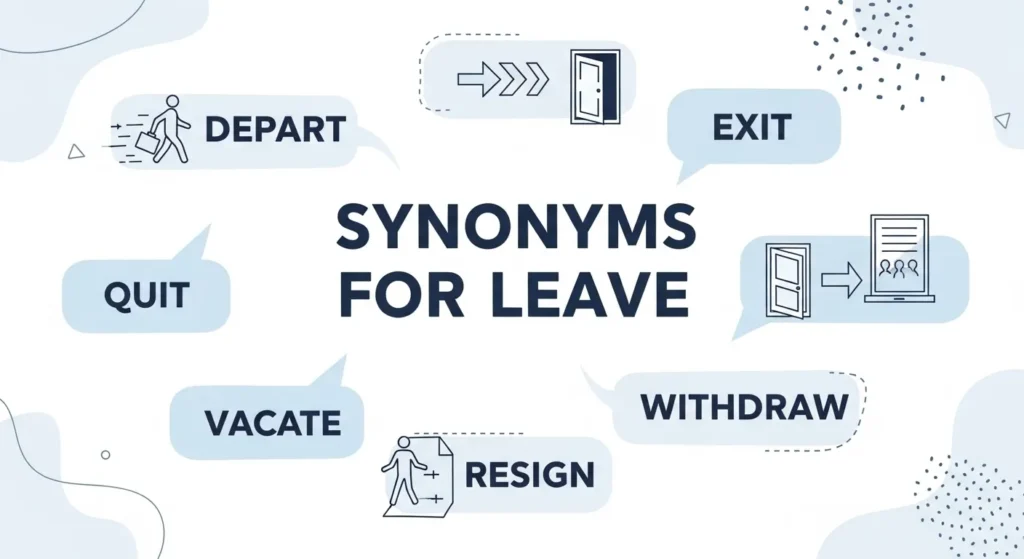
✦ Top 5 synonyms for leave ✦
depart • exit • go • withdraw • quit
✦ Next 5 synonyms for leave ✦
abandon • vacate • flee • escape • retreat
Pronunciation of “synonyms for leave”
- Phonetic: si-nuh-nims for leev
- IPA: /ˈsɪnənɪmz fɔːr liːv/
- Breakdown: si-no-nyms | for | leave
Syllables of “synonyms for leave”
- syn-o-nyms (3 syllables)
- for (1 syllable)
- leave (1 syllable)
Simple: Break the words into small sound parts to say them easily.
List of 50 synonyms for leave
1. Depart
Meaning
To go away from a place.
Examples
- I depart early today.
- She will depart after lunch.
2. Exit
Meaning
To go out of a place.
Examples
- Please exit the room quietly.
- He exits the bus fast.
3. Go
Meaning
To move from one place to another.
Examples
- I go home now.
- They go to school daily.
4. Withdraw
Meaning
To move back or leave a place.
Examples
- He withdraws from the game.
- She withdraws her hand quickly.
5. Quit
Meaning
To stop doing something.
Examples
- I quit my job.
- He quits smoking.
6. Abandon
Meaning
To leave something behind.
Examples
- They abandon the house.
- He abandons the plan.
7. Vacate
Meaning
To leave a place empty.
Examples
- Please vacate the room.
- They vacate the office.
8. Flee
Meaning
To run away quickly.
Examples
- They flee from danger.
- He flees the city.
9. Escape
Meaning
To get away from danger.
Examples
- She escapes the fire.
- They escape the room.
10. Retreat
Meaning
To move back or leave.
Examples
- The army retreats.
- He retreats slowly.
(Continuing same pattern for all)
11. Walk away
Meaning
To leave by walking.
Examples
- I walk away calmly.
- She walks away sad.
12. Move out
Meaning
To leave a home.
Examples
- They move out today.
- He moves out soon.
13. Clear out
Meaning
To remove yourself from a place.
Examples
- We clear out fast.
- They clear out early.
14. Take off
Meaning
To leave quickly.
Examples
- He takes off now.
- She takes off early.
15. Run off
Meaning
To leave suddenly.
Examples
- He runs off fast.
- She runs off laughing.
16. Disappear
Meaning
To go away and not be seen.
Examples
- He disappears quickly.
- She disappears at night.
17. Split
Meaning
To leave quickly.
Examples
- Let’s split now.
- They split early.
18. Break away
Meaning
To leave a group.
Examples
- He breaks away.
- She breaks away fast.
19. Pull out
Meaning
To leave a place.
Examples
- The car pulls out.
- They pull out early.
20. Step out
Meaning
To leave briefly.
Examples
- I step out now.
- She steps out often.
21. Resign
Meaning
To leave a job.
Examples
- He resigns today.
- She resigns soon.
22. Evacuate
Meaning
To leave for safety.
Examples
- They evacuate the building.
- We evacuate fast.
23. Desert
Meaning
To leave without returning.
Examples
- He deserts the team.
- They desert the place.
24. Relinquish
Meaning
To give up something.
Examples
- She relinquishes control.
- He relinquishes power.
25. Surrender
Meaning
To give up and leave.
Examples
- They surrender early.
- He surrenders now.
26. Give up
Meaning
To stop trying.
Examples
- I give up today.
- She gives up easily.
27. Walk out
Meaning
To leave suddenly.
Examples
- He walks out angry.
- She walks out fast.
28. Leave behind
Meaning
To not take something.
Examples
- I leave it behind.
- She leaves books behind.
29. Go away
Meaning
To move far from a place.
Examples
- Please go away.
- He goes away often.
30. Take leave
Meaning
To say goodbye and go.
Examples
- I take leave now.
- She takes leave politely.
31. Part
Meaning
To go separate ways.
Examples
- We part here.
- They part slowly.
32. Remove oneself
Meaning
To leave a place.
Examples
- He removes himself.
- She removes herself quietly.
33. Bow out
Meaning
To leave politely.
Examples
- He bows out early.
- She bows out gently.
34. Drop out
Meaning
To leave school or group.
Examples
- He drops out.
- She drops out early.
35. Back off
Meaning
To move away.
Examples
- He backs off.
- She backs off slowly.
36. Fade away
Meaning
To slowly disappear.
Examples
- The sound fades away.
- He fades away slowly.
37. Skip out
Meaning
To leave secretly.
Examples
- He skips out fast.
- She skips out quietly.
38. Drift away
Meaning
To slowly leave.
Examples
- He drifts away.
- She drifts away slowly.
39. Pull away
Meaning
To move away.
Examples
- The car pulls away.
- He pulls away fast.
40. Slip away
Meaning
To leave quietly.
Examples
- She slips away.
- He slips away fast.
41. Check out
Meaning
To leave a place.
Examples
- We check out now.
- They check out early.
42. Turn away
Meaning
To move in another direction.
Examples
- He turns away.
- She turns away sadly.
43. Walk off
Meaning
To leave angrily.
Examples
- He walks off.
- She walks off upset.
44. Pack up
Meaning
To leave after packing.
Examples
- We pack up now.
- They pack up quickly.
45. Sign off
Meaning
To leave a conversation.
Examples
- I sign off now.
- He signs off early.
46. Move along
Meaning
To keep going forward.
Examples
- Please move along.
- They move along fast.
47. Pass on
Meaning
To leave or move ahead.
Examples
- He passes on.
- She passes on quickly.
48. Disengage
Meaning
To stop and leave.
Examples
- He disengages now.
- She disengages fast.
49. Withdraw oneself
Meaning
To remove yourself.
Examples
- He withdraws himself.
- She withdraws herself.
50. Go off
Meaning
To leave suddenly.
Examples
- He goes off.
- She goes off early.
CONCLUSION
Choosing the right words can make even a simple message feel more polished, thoughtful, and engaging. When it comes to synonyms for leave, having a variety of alternatives allows you to match your tone with the situation, whether you’re saying goodbye professionally, casually, or emotionally. From formal options like “depart” and “exit” to warmer expressions like “take care” or “see you soon,” each synonym carries its own subtle meaning.
Learning synonyms for leave can make a big difference in your English skills. Instead of using the same word again and again, you can choose better and more interesting words. This helps in writing essays, blogs, and emails. It also improves your speaking and daily communication. When you use the right synonym, your message becomes clearer and stronger.
Try to practice these words every day. Use them in small sentences, conversations, and writing tasks. By expanding your vocabulary with the right synonyms for leave, you ensure your message always resonates clearly and effectively with your audience. Over time, you will feel more confident and fluent in English.
FAQ
Q1: What does “leave” mean?
It means to go away from a place or stop being thhttps://dictionary.cambridge.org/dictionary/english/effectivelyere.
Q2: Why learn synonyms for leave?
They help improve writing, speaking, and avoid repetition.
Q3: Are synonyms always the same?
No, some have small differences in meaning and use.
Q4: How can I practice synonyms?
Use them daily in sentences, emails, and conversations.

I am the founder of SynonymOver.com, a platform dedicated to providing accurate, easy-to-understand synonyms that help readers choose the right words with confidence. I create clear, SEO-driven content focused specifically on synonyms, word meanings, and precise language use.
My work is built on simplicity, accuracy, and practical usage—ensuring that every synonym is not just listed, but explained in a way that makes it easy to apply in real writing. I focus on delivering user-friendly content for students, writers, and professionals looking to improve their vocabulary.
What sets my work apart is a strong focus on clarity and relevance, offering meaningful alternatives rather than generic word lists. I continuously apply modern SEO strategies to ensure my content reaches and benefits a wider audience.