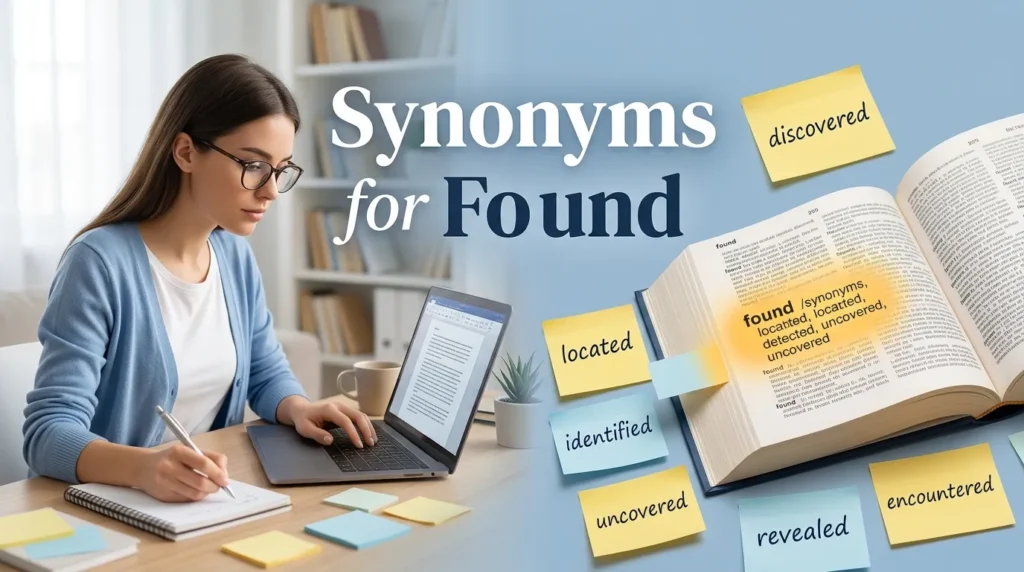
Have you ever searched for the perfect word while writing an email, essay, or social media post—only to realize that repeating the same word makes your content sound dull? The word “found” is one of the most commonly used terms in English, but using it too often can weaken your writing. That’s why learning different synonyms for found can instantly make your sentences more engaging, professional, and natural.
Imagine you are writing a school essay or a blog post. Instead of saying, “I found my keys,” every time, you can say “I discovered my keys” or “I located my keys.” Small word changes can make a big difference.
The phrase synonyms for found means words that have a similar meaning to “found.” These words help you speak and write better. They are useful for students, bloggers, content writers, and anyone who uses English every day.
When you learn synonyms for found, you can explain ideas more clearly. Teachers like rich vocabulary. Readers enjoy smooth writing. Even simple conversations become more interesting.
Bloggers use synonyms for found to avoid repetition in articles. Students use them in essays and homework. Content writers use them to improve SEO writing. Daily English users also enjoy sounding more confident.
If you want better communication skills, learning synonyms for found is a smart and easy step.
✨ Top 5 Synonyms for Found ✨
- Discover
- Locate
- Detect
- Identify
- Notice
✨ Next 5 Synonyms for Found ✨
- Observe
- Uncover
- Spot
- Learn
- Recognize
Pronunciation of “Synonyms for Found”
- Phonetic Spelling: sih-nuh-nims for found
- IPA Format: /ˈsɪn.ə.nɪmz fɔːr faʊnd/
- Simple Breakdown: Sin-uh-nims | for | Found
Syllables of “Synonyms for Found”
- Synonyms: syn-o-nyms
- For: for
- Found: found
“Synonyms” has 3 syllables, while “found” has 1 syllable.
List of 50 Synonyms for Found
Discover
Meaning
To learn about something for the first time.
Examples
- I discovered a new coffee shop today.
- She discovered an old photo in the drawer.
Locate
Meaning
To find the exact place of something.
Examples
- I located my bag under the table.
- Dad located the missing papers quickly.
Detect
Meaning
To notice something that is hard to see.
Examples
- The dog detected a strange smell.
- We detected smoke in the room.
Identify
Meaning
To know what something is.
Examples
- The teacher identified the mistake fast.
- Police identified the lost bike owner.
Notice
Meaning
To see or become aware of something.
Examples
- I noticed your new haircut today.
- She noticed a crack on the wall.
Observe
Meaning
To watch something carefully.
Examples
- We observed birds in the park.
- He observed the game quietly.
Uncover
Meaning
To reveal something hidden.
Examples
- The reporter uncovered the truth.
- We uncovered old coins in the yard.
Spot
Meaning
To see something quickly.
Examples
- I spotted my friend in the crowd.
- She spotted a rainbow after rain.
Learn
Meaning
To gain new knowledge.
Examples
- I learned a new recipe yesterday.
- He learned the answer online.
Recognize
Meaning
To know someone or something again.
Examples
- I recognized her voice instantly.
- They recognized the old building.
Encounter
Meaning
To meet something unexpectedly.
Examples
- We encountered heavy traffic today.
- She encountered a friendly dog outside.
Obtain
Meaning
To get something successfully.
Examples
- He obtained a library card yesterday.
- I obtained tickets for the concert.
Retrieve
Meaning
To bring something back.
Examples
- She retrieved her phone from the car.
- I retrieved my jacket from school.
Recover
Meaning
To get something back after losing it.
Examples
- He recovered his lost wallet.
- We recovered the deleted file.
Reach
Meaning
To arrive at something.
Examples
- We reached the station early.
- She reached the top shelf easily.
Track
Meaning
To follow something carefully.
Examples
- Rangers tracked the wild animal.
- I tracked my package online.
Trace
Meaning
To find the origin of something.
Examples
- Police traced the phone call.
- Scientists traced the water leak.
Catch
Meaning
To find or stop something moving.
Examples
- I caught the ball quickly.
- She caught the last bus home.
Meet
Meaning
To come across someone.
Examples
- I met my cousin at the mall.
- They met a famous actor yesterday.
Gain
Meaning
To get or receive something.
Examples
- She gained useful experience at work.
- We gained new customers this month.
Acquire
Meaning
To get something over time.
Examples
- He acquired strong writing skills.
- They acquired a small business recently.
Reveal
Meaning
To show something hidden.
Examples
- The test revealed the problem.
- She revealed her surprise gift.
Expose
Meaning
To make something visible.
Examples
- The sunlight exposed the dust.
- The article exposed fake news.
Unearth
Meaning
To dig up or discover something old.
Examples
- Workers unearthed ancient tools.
- We unearthed family records yesterday.
Bring to Light
Meaning
To make something known.
Examples
- The report brought mistakes to light.
- Her research brought facts to light.
Pinpoint
Meaning
To find the exact thing or place.
Examples
- Doctors pinpointed the illness quickly.
- I pinpointed the error in minutes.
Reveal
Meaning
To show something clearly.
Examples
- The map revealed a shortcut route.
- He revealed his travel plans yesterday.
Detect
Meaning
To discover signs of something.
Examples
- Machines detected the small crack.
- Nurses detected the fever early.
Notice
Meaning
To become aware of something.
Examples
- I noticed a bird outside.
- She noticed the open window quickly.
Realize
Meaning
To suddenly understand something.
Examples
- I realized my mistake later.
- He realized the shop was closed.
Understand
Meaning
To know the meaning of something.
Examples
- She understood the lesson easily.
- We understood his feelings clearly.
Observe
Meaning
To look at something carefully.
Examples
- Students observed the science experiment.
- I observed the baby sleeping peacefully.
Witness
Meaning
To see something happen.
Examples
- We witnessed a car accident today.
- She witnessed the beautiful sunset.
Come Across
Meaning
To find something by chance.
Examples
- I came across old letters yesterday.
- He came across a funny video online.
Hit Upon
Meaning
To suddenly discover an idea.
Examples
- She hit upon a smart solution.
- We hit upon a great restaurant.
Dig Up
Meaning
To discover hidden information.
Examples
- Reporters dug up old records.
- I dug up my childhood photos.
Turn Up
Meaning
To appear after being missing.
Examples
- My keys turned up today.
- The missing file turned up later.
Root Out
Meaning
To find and remove something bad.
Examples
- Police rooted out corruption quickly.
- Teachers rooted out cheating in class.
Ferret Out
Meaning
To search carefully for something hidden.
Examples
- Detectives ferreted out the secret papers.
- She ferreted out useful information online.
Seek Out
Meaning
To search for something actively.
Examples
- I sought out a better job.
- They sought out fresh ideas together.
Hunt Down
Meaning
To search until something is found.
Examples
- He hunted down the rare book.
- We hunted down cheap tickets online.
Pick Up
Meaning
To learn or get something casually.
Examples
- I picked up some French phrases.
- She picked up her order today.
Retrieve
Meaning
To get something back safely.
Examples
- He retrieved the ball from water.
- I retrieved my email password yesterday.
Discover
Meaning
To find something new.
Examples
- Kids discovered shells on the beach.
- Scientists discovered a new planet recently.
Find Out
Meaning
To learn information.
Examples
- I found out the meeting time.
- She found out the truth yesterday.
Search Out
Meaning
To look carefully for something.
Examples
- We searched out the best bakery.
- He searched out rare music albums.
Explore
Meaning
To look around and learn.
Examples
- Tourists explored the old castle.
- Children explored the forest trail.
Check Out
Meaning
To examine something closely.
Examples
- I checked out the new cafe.
- She checked out the book yesterday.
Scout
Meaning
To look for something or someone.
Examples
- Coaches scouted young players yesterday.
- We scouted the area before camping.
Probe
Meaning
To investigate deeply.
Examples
- Journalists probed the strange event.
- Police probed the missing case carefully.
Examine
Meaning
To look at something carefully.
Examples
- Doctors examined the injured player.
- I examined the painting closely today.
Investigate
Meaning
To study or search carefully.
Examples
- Officers investigated the loud noise.
- Scientists investigated the strange marks.
Conclusion
Learning synonyms for found can improve your writing, speaking, and daily communication. When you use different words, your sentences sound more interesting and natural. This skill is very useful for students, bloggers, content writers, and English learners.
Using synonyms for found also helps you avoid repeating the same word again and again. Your essays become stronger, your blogs become smoother, and your conversations become clearer.
Try practising these words in emails, school assignments, blog posts, and daily talks. Start with simple words like “discover” or “locate,” and slowly use more advanced ones too.
The more you practice, the more confident you will feel in English. Small vocabulary changes can create a big improvement in communication skills.
FAQ
What are synonyms for found?
Synonyms for found are words that have a similar meaning to “found,” such as discover, locate, identify, and detect.
Why should I learn synonyms for found?
Learning synonyms improves writing, speaking, reading, and vocabulary skills. It also helps avoid repeating the same word too often.
Which synonym for found is best for essays?
Words like “discover,” “identify,” “observe,” and “locate” work very well in essays and formal writing.
Can students use synonyms for found in school work?
Yes, students can use these synonyms in essays, homework, presentations, and daily English practice.
Are synonyms for found useful for SEO writing?
Yes, using different related words improves readability and helps content sound more natural for readers and search engines.

I am the founder of SynonymOver.com, a platform dedicated to providing accurate, easy-to-understand synonyms that help readers choose the right words with confidence. I create clear, SEO-driven content focused specifically on synonyms, word meanings, and precise language use.
My work is built on simplicity, accuracy, and practical usage—ensuring that every synonym is not just listed, but explained in a way that makes it easy to apply in real writing. I focus on delivering user-friendly content for students, writers, and professionals looking to improve their vocabulary.
What sets my work apart is a strong focus on clarity and relevance, offering meaningful alternatives rather than generic word lists. I continuously apply modern SEO strategies to ensure my content reaches and benefits a wider audience.