Have you ever spent several minutes searching for the perfect word, only to realize that the same term keeps appearing again and again in your writing? Whether you’re crafting an email, writing an essay, or creating online content, using the right vocabulary can make your message more engaging and professional. That’s where understanding synonyms for find becomes incredibly useful.
Learning synonyms for find can make your writing stronger and your speech more engaging. Whether you are trying to find information online, find your lost keys, or find a solution to a problem, there are many other words you can use depending on the situation.
For example, imagine a student searching for a book in the library. Instead of saying, “I need to find the book,” they could say, “I need to locate the book” or “I need to discover the book.” Small changes like these make communication more colorful and precise.
The word find means to discover, locate, or get something after looking for it. It is a common word used every day by students, bloggers, content writers, and English learners. Understanding different synonyms for find helps improve vocabulary, avoids repetition, and makes writing more professional.
If you want to become more confident in English, learning these synonyms for find is a great place to start.
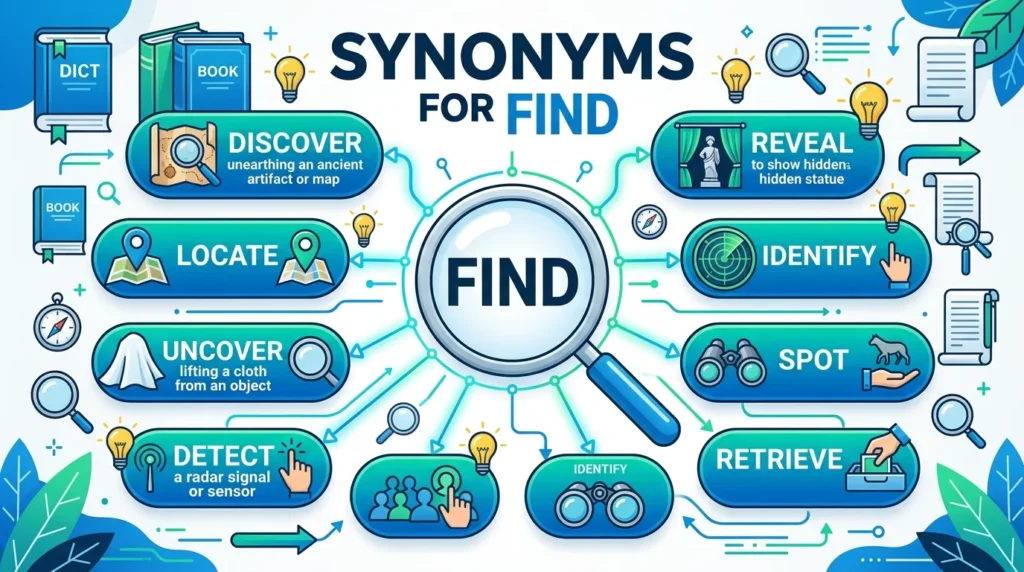
✨ Top 5 Synonyms for Find ✨
- Discover
- Locate
- Detect
- Uncover
- Identify
✨ Next 5 Synonyms for Find ✨
- Spot
- Observe
- Notice
- Encounter
- Reveal
Pronunciation of “Find”
Phonetic Spelling: find
IPA Format: /faɪnd/
Simple Breakdown:
find = f + ind
Syllables of “Find”
Syllable Breakdown: find
The word find has 1 syllable.
It is spoken in one smooth sound: find.
List of 50 Synonyms for Find
Discover
Meaning
To learn about something for the first time.
Examples
- I discovered a new game today.
- She discovered a nice café nearby.
Locate
Meaning
To find the exact place of something.
Examples
- Can you locate my phone?
- We located the missing bag.
Detect
Meaning
To notice something that is hard to see.
Examples
- The machine detected a problem.
- I detected a strange smell.
Uncover
Meaning
To find something hidden.
Examples
- The police uncovered new evidence.
- We uncovered an old photo album.
Identify
Meaning
To recognize or name something correctly.
Examples
- I identified the bird quickly.
- She identified the correct answer.
Spot
Meaning
To see something suddenly.
Examples
- I spotted my friend in the crowd.
- He spotted a rabbit in the field.
Observe
Meaning
To watch something carefully.
Examples
- We observed the stars tonight.
- The teacher observed the class.
Notice
Meaning
To become aware of something.
Examples
- Did you notice the new sign?
- I noticed a change in her voice.
Encounter
Meaning
To meet something unexpectedly.
Examples
- We encountered heavy rain.
- She encountered a friendly dog.
Reveal
Meaning
To show something that was hidden.
Examples
- The report revealed important facts.
- He revealed the surprise early.
Recognize
Meaning
To know someone or something from before.
Examples
- I recognized her instantly.
- He recognized the song.
Learn
Meaning
To gain knowledge about something.
Examples
- I learned a new skill.
- She learned the truth yesterday.
Track Down
Meaning
To find something after searching.
Examples
- I tracked down the document.
- They tracked down the owner.
Come Across
Meaning
To find something by chance.
Examples
- I came across an old letter.
- She came across useful advice.
Obtain
Meaning
To get something successfully.
Examples
- He obtained a permit.
- We obtained the needed files.
Secure
Meaning
To get something safely.
Examples
- She secured a good seat.
- We secured extra tickets.
Retrieve
Meaning
To get something back.
Examples
- I retrieved my jacket.
- He retrieved the lost ball.
Recover
Meaning
To find or get back something lost.
Examples
- They recovered the missing bike.
- She recovered her notes.
Reach
Meaning
To get to a place or result.
Examples
- We reached the station early.
- He reached the solution quickly.
Attain
Meaning
To achieve or get something.
Examples
- She attained her goal.
- He attained a high score.
Acquire
Meaning
To get or gain something.
Examples
- I acquired a new laptop.
- She acquired useful skills.
Unearth
Meaning
To find something hidden or buried.
Examples
- Workers unearthed old coins.
- They unearthed valuable records.
Expose
Meaning
To bring something into view.
Examples
- The article exposed the mistake.
- Sunlight exposed the marks.
Pinpoint
Meaning
To find something exactly.
Examples
- We pinpointed the issue.
- She pinpointed the location.
Ascertain
Meaning
To find out something for certain.
Examples
- We ascertained the facts.
- He ascertained the reason.
Determine
Meaning
To figure out the correct answer.
Examples
- We determined the cause.
- She determined the best route.
Verify
Meaning
To check if something is true.
Examples
- Please verify the address.
- I verified the information.
Search Out
Meaning
To look carefully until something is found.
Examples
- We searched out the file.
- She searched out a solution.
Hunt Down
Meaning
To find after a long search.
Examples
- He hunted down the seller.
- They hunted down the missing record.
Explore
Meaning
To look around and discover things.
Examples
- We explored the town.
- She explored new ideas.
Seek
Meaning
To try to find something.
Examples
- I seek better opportunities.
- They seek useful information.
Trace
Meaning
To follow and find something.
Examples
- Police traced the call.
- We traced the source.
Detective Out
Meaning
To discover through careful investigation.
Examples
- He detectived out the answer.
- She detectived out the truth.
Scout
Meaning
To search for something useful.
Examples
- We scouted a new location.
- He scouted talent for the team.
Investigate
Meaning
To examine something carefully.
Examples
- Officers investigated the case.
- We investigated the issue.
Examine
Meaning
To look at something closely.
Examples
- The doctor examined my arm.
- She examined the report.
Inspect
Meaning
To check something carefully.
Examples
- They inspected the building.
- He inspected the equipment.
Probe
Meaning
To investigate deeply.
Examples
- The team probed the problem.
- Reporters probed the story.
Research
Meaning
To study information to learn more.
Examples
- I researched the topic.
- She researched the company.
Check Out
Meaning
To look at something and learn about it.
Examples
- Check out this website.
- We checked out the new store.
Gather
Meaning
To collect information or items.
Examples
- We gathered facts.
- She gathered the papers.
Collect
Meaning
To bring things together.
Examples
- I collected the books.
- He collected useful data.
Source
Meaning
To find where something comes from.
Examples
- We sourced local materials.
- She sourced reliable information.
Access
Meaning
To reach or obtain something.
Examples
- I accessed the file.
- He accessed the database.
Reach
Meaning
To get to something.
Examples
- We reached the destination.
- She reached a conclusion.
Get
Meaning
To obtain or receive something.
Examples
- I got a new notebook.
- He got the answer.
Obtain
Meaning
To successfully get something.
Examples
- She obtained permission.
- We obtained the documents.
Turn Up
Meaning
To be found unexpectedly.
Examples
- My keys turned up later.
- The missing paper turned up.
Dig Up
Meaning
To find something after searching.
Examples
- I dug up an old photo.
- He dug up useful records.
Stumble Upon
Meaning
To find something by accident.
Examples
- I stumbled upon a great article.
- She stumbled upon an old friend.
Complete List of 50 Synonyms for Find
- Discover
- Locate
- Detect
- Uncover
- Identify
- Spot
- Observe
- Notice
- Encounter
- Reveal
- Recognize
- Learn
- Track Down
- Come Across
- Obtain
- Secure
- Retrieve
- Recover
- Reach
- Attain
- Acquire
- Unearth
- Expose
- Pinpoint
- Ascertain
- Determine
- Verify
- Search Out
- Hunt Down
- Explore
- Seek
- Trace
- Detective Out
- Scout
- Investigate
- Examine
- Inspect
- Probe
- Research
- Check Out
- Gather
- Collect
- Source
- Access
- Reach
- Get
- Obtain
- Turn Up
- Dig Up
- Stumble Upon
FAQ About Synonyms for Find
What are synonyms for find?
Synonyms for find are words that have a similar meaning to “find.” Examples include discover, locate, identify, uncover, and detect.
Why should I learn synonyms for find?
Learning synonyms helps you avoid repeating the same word. It improves writing, speaking, blogging, and communication skills.
Which synonym is best for academic writing?
Words like discover, identify, determine, ascertain, and investigate work well in academic and professional writing.
Which synonym means finding something by accident?
“Come across” and “stumble upon” are commonly used when you find something unexpectedly.
Are all synonyms for find interchangeable?
No. Some synonyms fit specific situations. For example, “locate” is used for places, while “discover” is often used for new information.
Conclusion
Learning different synonyms for find can make your writing more engaging, precise, and professional. Whether you want to discover new information, locate a lost item, identify a problem, or uncover hidden details, choosing the right alternative helps you communicate your message more effectively. Each synonym carries its own subtle meaning, making it easier to express exactly what you intend in both casual conversations and formal writing.
Whether you are a student writing essays, a blogger creating content, a professional sending emails, or someone who simply wants better English skills, using different words instead of repeating “find” can make a big difference.
Practice these synonyms regularly in your daily conversations, school assignments, blog posts, and emails. The more you use them, the more confident you will become. Over time, you will discover that a rich vocabulary helps you communicate with greater accuracy and style.
By expanding your vocabulary with these synonyms for find, you can avoid repetition, improve readability, and add variety to your content. The next time you use the word “find,” consider whether a more specific alternative might better fit the context and strengthen your communication.

I am the founder of SynonymOver.com, a platform dedicated to providing accurate, easy-to-understand synonyms that help readers choose the right words with confidence. I create clear, SEO-driven content focused specifically on synonyms, word meanings, and precise language use.
My work is built on simplicity, accuracy, and practical usage—ensuring that every synonym is not just listed, but explained in a way that makes it easy to apply in real writing. I focus on delivering user-friendly content for students, writers, and professionals looking to improve their vocabulary.
What sets my work apart is a strong focus on clarity and relevance, offering meaningful alternatives rather than generic word lists. I continuously apply modern SEO strategies to ensure my content reaches and benefits a wider audience.