Have you ever struggled to describe exactly how you felt in a particular moment? Maybe you were writing a heartfelt message, a school essay, or an important email and realized that the word “felt” appeared over and over again. That’s when exploring synonyms for felt can completely transform your writing. The right alternative can add depth, emotion, and precision, helping your readers connect more strongly with your message.
The phrase synonyms for felt refers to words that can replace felt depending on the situation. These words help describe emotions, thoughts, physical sensations, and personal experiences in a clearer way. Whether you are writing a school essay, a blog post, a story, or a social media caption, learning synonyms for felt can make your message stronger.
For example, instead of saying, “I felt nervous before the test,” you could say, “I experienced nervousness before the test” or “I sensed tension before the test.” These small changes can make your writing sound more natural and engaging.
Students use synonyms for felt to improve essays. Bloggers and content writers use them to avoid repetition. Daily English users can use them to communicate ideas more clearly. By learning synonyms for felt, you can express emotions and experiences with greater confidence and variety.
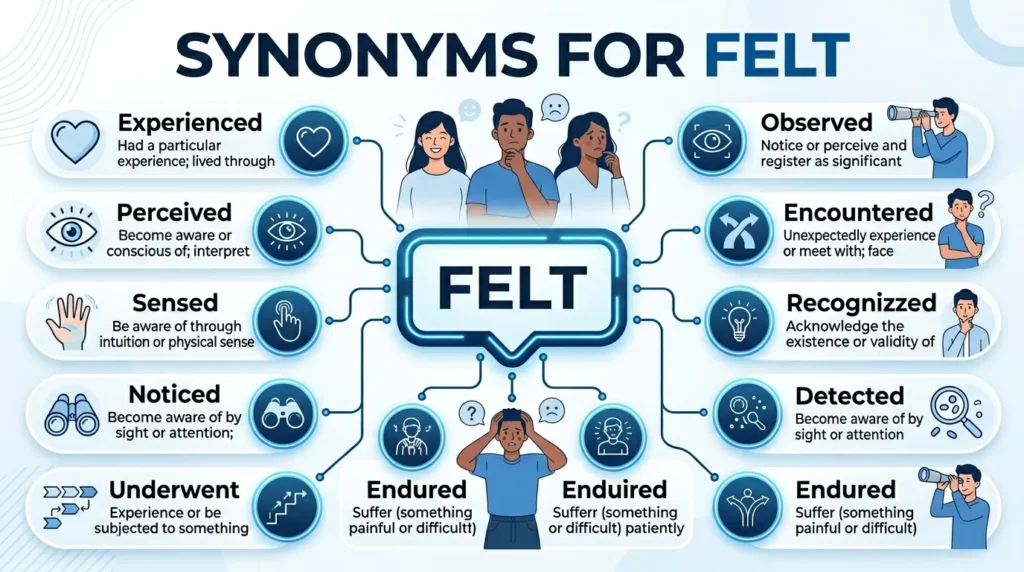
✨ Top 5 Synonyms for Felt ✨
Experienced • Sensed • Perceived • Noticed • Detected
✨ Next 5 Synonyms for Felt ✨
Observed • Understood • Realized • Recognized • Appreciated
Pronunciation of “Felt”
Phonetic Spelling: felt
IPA Format: /felt/
Simple Breakdown: felt (one smooth sound)
Syllables of “Felt”
Syllable Breakdown: felt
The word felt has 1 syllable. It is short and easy to pronounce.
List of 50 Synonyms for Felt
Experienced
Meaning
To go through something personally.
Examples
- I experienced great joy at the party.
- She experienced a busy day at work.
Sensed
Meaning
To become aware of something.
Examples
- I sensed a problem right away.
- She sensed excitement in the room.
Perceived
Meaning
To notice or understand something.
Examples
- He perceived a change in her voice.
- They perceived danger ahead.
Noticed
Meaning
To see or become aware of something.
Examples
- I noticed a new shop today.
- She noticed the missing book.
Detected
Meaning
To discover something that is present.
Examples
- The machine detected smoke.
- I detected a strange smell.
Observed
Meaning
To watch something carefully.
Examples
- We observed the birds outside.
- She observed the children playing.
Understood
Meaning
To know the meaning of something.
Examples
- I understood the lesson today.
- He understood the instructions.
Realized
Meaning
To become aware of a fact.
Examples
- I realized my mistake later.
- She realized the answer quickly.
Recognized
Meaning
To identify someone or something.
Examples
- I recognized my old friend.
- He recognized the song instantly.
Appreciated
Meaning
To value or enjoy something.
Examples
- I appreciated your help.
- She appreciated the kind words.
Knew
Meaning
To have information or understanding.
Examples
- I knew the result already.
- He knew the correct path.
Endured
Meaning
To suffer through something difficult.
Examples
- She endured a long journey.
- They endured cold weather.
Encountered
Meaning
To meet or face something.
Examples
- I encountered a problem today.
- He encountered heavy traffic.
Underwent
Meaning
To experience a process or event.
Examples
- She underwent training last month.
- He underwent a medical test.
Witnessed
Meaning
To see something happen.
Examples
- I witnessed the event yesterday.
- They witnessed a beautiful sunset.
Discerned
Meaning
To notice something carefully.
Examples
- She discerned a small difference.
- I discerned a pattern in the data.
Comprehended
Meaning
To fully understand something.
Examples
- He comprehended the topic well.
- I comprehended the message quickly.
Grasped
Meaning
To understand an idea clearly.
Examples
- She grasped the concept fast.
- I grasped the lesson today.
Identified
Meaning
To recognize or name something.
Examples
- We identified the issue early.
- He identified the correct answer.
Registered
Meaning
To become aware of something.
Examples
- The news finally registered with me.
- Her words registered immediately.
Acknowledged
Meaning
To accept or recognize something.
Examples
- He acknowledged the mistake.
- She acknowledged their support.
Interpreted
Meaning
To explain the meaning of something.
Examples
- I interpreted the sign correctly.
- She interpreted the message differently.
Reacted To
Meaning
To respond to something.
Examples
- He reacted to the joke quickly.
- I reacted to the news calmly.
Responded To
Meaning
To answer or react to something.
Examples
- She responded to the email promptly.
- I responded to his question.
Sympathized
Meaning
To share another person’s feelings.
Examples
- I sympathized with her situation.
- He sympathized with the injured player.
Believed
Meaning
To think something is true.
Examples
- I believed his story.
- She believed the good news.
Considered
Meaning
To think about something carefully.
Examples
- He considered the offer.
- I considered several options.
Thought
Meaning
To use your mind to form ideas.
Examples
- I thought about the trip.
- She thought the movie was great.
Assumed
Meaning
To think something is true without proof.
Examples
- He assumed I was busy.
- I assumed the shop was open.
Supposed
Meaning
To believe something may be true.
Examples
- She supposed it would rain.
- I supposed he was right.
Viewed
Meaning
To think about something in a certain way.
Examples
- He viewed the change positively.
- I viewed it as a learning chance.
Regarded
Meaning
To think about someone or something in a certain way.
Examples
- She regarded him as honest.
- They regarded the plan as useful.
Deemed
Meaning
To judge or consider something.
Examples
- The idea was deemed helpful.
- He deemed the task important.
Judged
Meaning
To form an opinion about something.
Examples
- I judged the book by its cover.
- She judged the contest fairly.
Concluded
Meaning
To reach a final opinion.
Examples
- We concluded the meeting early.
- He concluded that it was safe.
Gathered
Meaning
To understand from information.
Examples
- I gathered that she was tired.
- He gathered the news quickly.
Inferred
Meaning
To reach a conclusion from clues.
Examples
- She inferred the answer.
- I inferred his meaning.
Intuited
Meaning
To understand without direct proof.
Examples
- He intuited the problem.
- I intuited her concern.
Empathized
Meaning
To understand another person’s feelings.
Examples
- I empathized with the student.
- She empathized with her friend.
Related To
Meaning
To connect with someone’s experience.
Examples
- I related to his story.
- She related to the character.
Shared
Meaning
To have the same feeling or experience.
Examples
- We shared the excitement.
- They shared the concern.
Touched
Meaning
To be emotionally moved.
Examples
- I was touched by the gift.
- She was touched by the letter.
Moved
Meaning
To feel strong emotion.
Examples
- He was moved by the speech.
- I was moved by the song.
Affected
Meaning
To be influenced by something.
Examples
- The news affected me deeply.
- She was affected by the weather.
Impressed
Meaning
To admire something greatly.
Examples
- I was impressed by the performance.
- He was impressed by her skills.
Troubled
Meaning
To feel worried or upset.
Examples
- The report troubled me.
- She was troubled by the mistake.
Hurt
Meaning
To feel emotional or physical pain.
Examples
- His words hurt me.
- She hurt her knee yesterday.
Delighted
Meaning
To feel very happy.
Examples
- I was delighted with the result.
- She was delighted to see us.
Encouraged
Meaning
To feel more confident.
Examples
- I felt encouraged after the talk.
- He felt encouraged by the feedback.
Inspired
Meaning
To feel motivated to do something.
Examples
- I felt inspired by the book.
- She felt inspired to help others.
FAQ About Synonyms for Felt
What does the word “felt” mean?
The word felt is the past tense of feel. It means experiencing an emotion, physical sensation, thought, or reaction.
Why should I learn synonyms for felt?
Learning synonyms for felt helps you avoid repeating the same word. It also makes your writing clearer, stronger, and more interesting.
Which synonym for felt is best for emotions?
Words like experienced, empathized, touched, moved, and delighted work well when talking about emotions.
Which synonym for felt is best for understanding something?
Words such as realized, understood, grasped, comprehended, and recognized are useful when describing understanding.
Can students use these synonyms in essays?
Yes. Students can use these synonyms to improve vocabulary, reduce repetition, and make essays sound more professional.
Conclusion
Expanding your vocabulary with the best synonyms for felt can make your writing more precise, expressive, and engaging. Whether you want to describe an emotion, a physical sensation, or a personal experience, choosing alternatives such as experienced, sensed, perceived, noticed, endured, or understood helps convey your message with greater clarity and impact. The right word can add depth to your communication and prevent repetitive language.
Learning synonyms for felt is one of the easiest ways to improve your English vocabulary. Instead of using the same word repeatedly, you can choose alternatives that match the exact meaning you want to express.
These words can make your writing more engaging, your speaking more natural, and your communication more effective. Students can use them in assignments and essays. Bloggers and content writers can use them to create richer content. Daily English users can use them in conversations, emails, and messages.
The best way to remember these synonyms is through practice. Try using a few new words each day in your writing and conversations. Over time, these alternatives will become a natural part of your vocabulary and help you express yourself with greater confidence.

I am the founder of SynonymOver.com, a platform dedicated to providing accurate, easy-to-understand synonyms that help readers choose the right words with confidence. I create clear, SEO-driven content focused specifically on synonyms, word meanings, and precise language use.
My work is built on simplicity, accuracy, and practical usage—ensuring that every synonym is not just listed, but explained in a way that makes it easy to apply in real writing. I focus on delivering user-friendly content for students, writers, and professionals looking to improve their vocabulary.
What sets my work apart is a strong focus on clarity and relevance, offering meaningful alternatives rather than generic word lists. I continuously apply modern SEO strategies to ensure my content reaches and benefits a wider audience.